Sub-2 Hours: Sabastian Sawe and Tigst Assefa Just Rewrote Marathon History at London 2026
It happened. The barrier that has defined men's distance running for the better part of a decade fell on the streets of London this morning. Kenya's Sabastian Sawe crossed the line on The Mall in 1 hour, 59 minutes and 30 seconds, becoming the first athlete in history to officially break two hours for the marathon in a record-eligible race.
One minute and 5 seconds came off Kelvin Kiptum's 2:00:35 Chicago world record from 2023. Eliud Kipchoge's 1:59:40 from the 2019 INEOS 1:59 Challenge in Vienna was an exhibition. Today, in a legal, world-ranked, mass-participation marathon, the two-hour wall came down for real.
And then, half an hour after Sawe finished, defending champion Tigst Assefa broke her own women-only world record to win the women's race in 2:15:41. The first time three women had ever finished inside 2:16 in the same race.
This is not a normal Sunday in London.
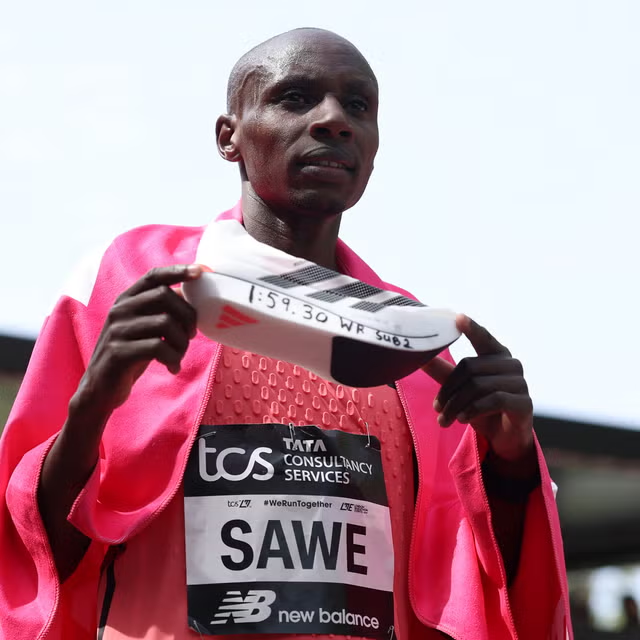
Watch the moment Sawe crossed the line for the first ever legal sub-2 marathon.
Why this matters for you: The barriers fell because training has changed. Concurrent strength, conditioning and running, sequenced properly, is no longer a fringe approach. It is the new mainstream. If you are planning your next marathon, the question is not whether to lift. It is how to integrate it.
The Men's Race: Two Sub-2 Hour Marathons in One Morning
The lead pack set out with intent from the gun. Sawe, Ethiopia's Yomif Kejelcha, three-time world cross-country champion Jacob Kiplimo of Uganda, Olympic champion Tamirat Tola, 2022 London winner Amos Kipruto and Deresa Geleta hit 5km in 14:14, on a 2:00:03 marathon pace from the very first kilometre.
They reached 10km in 28:34. 15km in 43:10. Halfway in 1:00:29.
The decisive move came between 30 and 35 kilometres. A 13:54 5km split shattered the lead group. Kiplimo, despite being one of the greatest distance runners alive, was dropped 21 seconds back. Sawe and Kejelcha were alone, and the maths was suddenly simple: keep this pace, and history falls.
The next 5km was even faster. 13:42. With one mile to go, Sawe finally broke clear of his Ethiopian shadow and pressed for home. He crossed the line in 1:59:30. Kejelcha came home 11 seconds later in 1:59:41, the same time Kipchoge ran in Vienna in 2019, and a marathon debut faster than any in history. Kiplimo took third in 2:00:28, also inside the previous world record.
Three men inside Kiptum's old world record on the same course on the same day. Six men inside 2:04. The greatest men's marathon ever staged.
Men's Top 10
- Sabastian Sawe (KEN) 1:59:30 WR
- Yomif Kejelcha (ETH) 1:59:41 ER, debut
- Jacob Kiplimo (UGA) 2:00:28 NR
- Amos Kipruto (KEN) 2:01:39
- Tamirat Tola (ETH) 2:02:59
- Deresa Geleta (ETH) 2:03:23
- Addisu Gobena (ETH) 2:05:23
- Geoffrey Kamworor (KEN) 2:05:38
- Peter Lynch (IRL) 2:06:08
- Mahamed Mahamed (GBR) 2:06:14
The Women's Race: Three Inside 2:16, A New Era
The women's elite race is, somehow, the second story of the day, and it is still extraordinary.
Defending champion Tigst Assefa lined up with a target. Two-time Boston and New York champion Hellen Obiri was making her London debut. 2021 London winner Joyciline Jepkosgei completed a leading quartet alongside Catherine Reline Amanang'ole. From the gun, the pace was historic.
5km in 15:39. 10km in 31:03. The chase pack was already minutes back. Amanang'ole drifted off before 15km, leaving the three favourites to settle the race between themselves. Halfway came in 1:06:12, half a minute quicker than Assefa's record-breaking run last year.
The trio ran together through the second half, the pace easing slightly as the wind picked up on the Embankment. A sub-2:15 finish slipped out of reach, but Assefa's existing women-only world record was always within range.
In the closing kilometres, Assefa edged clear. She crossed the line in 2:15:41, taking 9 seconds off her own global mark. Obiri finished second in 2:15:53, a personal best on debut. Jepkosgei third in 2:15:55. The first time in history three women had finished inside 2:16 in the same marathon.
Women's Top 10
- Tigst Assefa (ETH) 2:15:41 Women-only WR
- Hellen Obiri (KEN) 2:15:53 PB
- Joyciline Jepkosgei (KEN) 2:15:55
- Degitu Azimeraw (ETH) 2:19:13
- Catherine Reline Amanang'ole (KEN) 2:21:20
- Eunice Chumba (BRN) 2:23:44
- Eilish McColgan (GBR) 2:24:51
- Julia Paternain (URU) 2:25:47
- Rose Harvey (GBR) 2:26:14
- Marta Galimany (ESP) 2:27:38
The Wheelchair Races
Marcel Hug Wins Again
Switzerland's Marcel Hug took his record-equalling eighth London Marathon men's wheelchair title in 1:24:13. China's Luo Xingchuan was second in 1:28:46, with David Weir of Great Britain third in 1:29:23.
Debrunner Three In A Row
Catherine Debrunner of Switzerland won her fourth London title and third in succession in 1:38:29. American Tatyana McFadden was second in 1:38:34, with Manuela Schar third in 1:41:21.
What Just Changed
For most of the last decade, the sub-two-hour marathon has been the holy grail of distance running. The first time a human ran 26.2 miles in under two hours was in Vienna in 2019, with Eliud Kipchoge in a controlled exhibition with rotating pacers and a delivered hydration system. It did not count.
Today counted. Open course. Standard pacers. Two athletes inside two hours. A third man inside the previous world record. The greatest marathon performance in human history, on the streets of London.
Read the full World Athletics race report here. The minute-by-minute live blog from Olympics.com captures how the race unfolded as it happened.
The barrier was psychological as much as physiological. For 60 years, sub-2 was the line that defined what was possible. Now it is the new normal. The next generation of athletes will train with that as a baseline, not a ceiling.
What This Means for Your Next Marathon
Here is the part that matters for the 11,500+ athletes already training with Edge, and for anyone reading this with a marathon on the calendar.
The athletes at the front of London this morning did not get there with running alone. Modern marathon training, at every level from Sawe down to the recreational ballot runner, now includes structured strength work, deliberate conditioning, and recovery built into the programme rather than added on top. The interference effect has been quietly buried by a generation of athletes who refused to pick a lane.
If you ran London today, your block starts again next week. If you are eyeing Berlin, Chicago, New York, or Valencia later this year, your block starts now. If you are training for your first marathon, this morning is the proof that the sport is moving and you can move with it.
Edge programmes your running, strength and conditioning as one system. Not three apps. Not a generic 16-week PDF. A plan that knows what you did yesterday and adjusts what you do today.
Train for your next marathon, the modern way
Hybrid training built around your running. Personalised, progressive, and free for 6 months when you start today. 11,500+ athletes are already in.
Get Edge Free for 6 MonthsThe Headline
Sub-2 happened in London. Three women under 2:16 happened in London. The fastest marathon in history, top to bottom, happened in London.
If you needed a reason to start your next training block today, you just got two of them.
Your next marathon starts here
Whatever distance, whatever level. Edge builds the plan around you, not the other way around.
Start Free for 6 Months